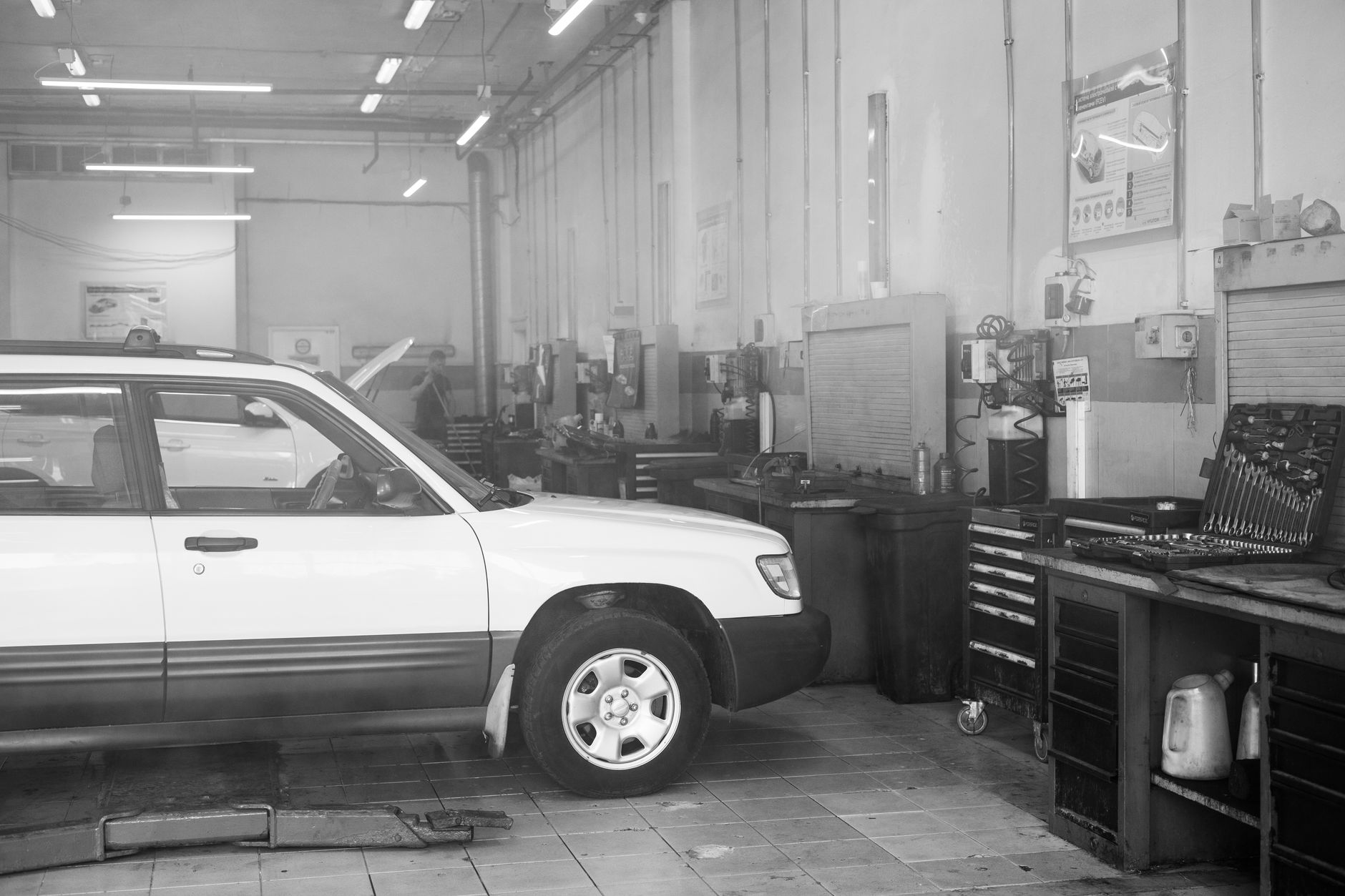
Why does an automotive garage complicate the choice of fire detectors?
A garage or automotive repair workshop combines several sources that disrupt conventional smoke detectors: grinding dust, welding fumes, fuel or solvent vapours. An optical smoke detector installed without prior consideration will trigger false alarms in these environments, which often leads operators to disable it, with the opposite risk: no longer detecting a real fire outbreak.
The NBN S21-100-1 standard, which governs the design and installation of fire detection systems in Belgium, requires a risk analysis per room before selecting equipment. An automotive garage is never a homogeneous building: the inspection pit, mechanical workshop, paint booth and welding station present completely different risk profiles, and must therefore be treated as distinct zones rather than covered by a single type of detector.
Which detection technology works in a workshop with grinding dust?
In grinding, sanding or cutting areas, conventional optical smoke detectors should be avoided: airborne dust particles scatter light as real smoke would and cause false alarms. The choice generally falls on heat detectors (rate-of-rise, sensitive to the speed of temperature increase) or on multi-criteria detectors combining optical and thermal analysis, whose algorithm better filters false positives related to dust.
Some manufacturers offer so-called "dust-resistant" optical chambers, with reinforced insect screens and specific signal processing, but their relevance must be validated based on the room's risk analysis, as required by NBN S21-100-1. In workshops where dust is permanent and significant, linear heat detection cable on the ceiling can also be considered, particularly under high roofs where access to point detectors is difficult.
How to manage welding fumes without multiplying false alarms?
Welding stations generate fumes and fine particles that easily fool a standard optical smoke detector, just like an ionisation detector, now almost no longer used in Belgian installations. The most reliable solution remains the heat detector in a perimeter close to the station, supplemented by a flame detector (infrared or ultraviolet) if the risk of spark projection towards combustible materials is real.
Another approach consists of excluding the welding station itself from automatic smoke detection coverage, while reinforcing heat detection in the immediate area and conventional smoke detection in adjacent rooms where welding fumes do not normally penetrate. This segmentation avoids sacrificing the overall reliability of the system for a single workstation with particular risk.
Fuel vapours: which detection near unloading or painting stations?
Areas where fuel or solvent vapours can accumulate (unloading, paint booth, flammable liquid storage) require consideration at two levels: fire detection proper, and explosive gas detection, which is a distinct discipline falling under the building's ATEX analysis.
For fire detection in these zones, flame detectors are often preferred over smoke detectors, because a fire outbreak on flammable vapours first manifests as a rapid flame rather than a detectable smoke plume upstream. If the zone is classified as an explosive atmosphere, all equipment installed within the perimeter, including fire detectors, must be certified for this use according to European ATEX regulations, which excludes placing a non-certified standard fire detector there.
ATEX zone and fire detection: what concrete difference?
An ATEX zone ("zone ATEX" in Belgian terminology) is a perimeter defined by the building's explosion risk analysis, classified according to the probability of presence of an explosive atmosphere (gas, vapours or dust), and distinct from the notion of fire detection zone defined by NBN S21-100-1. Confusing the two leads to costly design errors.
Concretely, an ATEX zone requires that all electrical equipment installed inside, including fire detectors themselves, be certified for this type of atmosphere. Outside the ATEX perimeter, standard fire detectors, BOSEC certified, remain normally applicable. This is why the ATEX zoning plan of an automotive garage (often limited to fuel unloading or the paint booth) must be established before drawing up the fire detector layout, not the reverse. The Code on Well-being at Work ("Code du bien-être au travail" in Belgian terminology), Book III, Title 3, frames fire prevention in the workplace and articulates with this risk analysis.
How to distribute detection zones in a multi-activity garage?
An automotive garage benefits from being divided into functional zones, each associated with a detection technology adapted to its dominant risk rather than a single choice applied everywhere.
| Garage zone | Dominant risk | Recommended technology |
|---|---|---|
| General mechanical workshop | Dust, low dust level | Optical smoke detector or multi-criteria |
| Grinding / sanding station | Dense dust | Heat detector or linear heat-sensing cable |
| Welding station | Fumes, projections | Heat detector, flame detector if projections |
| Paint booth | Solvent vapours, potentially ATEX atmosphere | Flame detector certified according to ATEX zoning |
| Inspection pit / fuel unloading | Vapours, ATEX risk | ATEX certified equipment if classified as explosive zone |
| Tyre / parts storage | Solid combustibles | Conventional optical smoke detector |
This distribution must explicitly appear in the risk analysis file and layout plan required by NBN S21-100-1, not from a simple installer habit.
Who inspects the fire detection installation of an automotive garage?
Periodic inspection of a fire detection installation in a garage falls under NBN S21-100-2, which sets maintenance and verification requirements, with operations to be performed by a qualified technician at regular intervals. The emergency zone ("zone de secours" in Belgian terminology) competent for the garage's territory provides an opinion on the file and can conduct an on-site inspection, particularly within the framework of operation or the environmental permit.
In ATEX classified zones, maintenance must also verify that equipment remains compliant with its original certification, a point that BOSEC certified installers integrate into their maintenance plan. The ANPI organisation can also support the operator in the preliminary risk analysis, particularly when the garage combines several activities (mechanics, bodywork, painting) under the same building classified according to the Royal Decree of 7 July 1994 ("arrêté royal du 7 juillet 1994" in Belgian terminology).