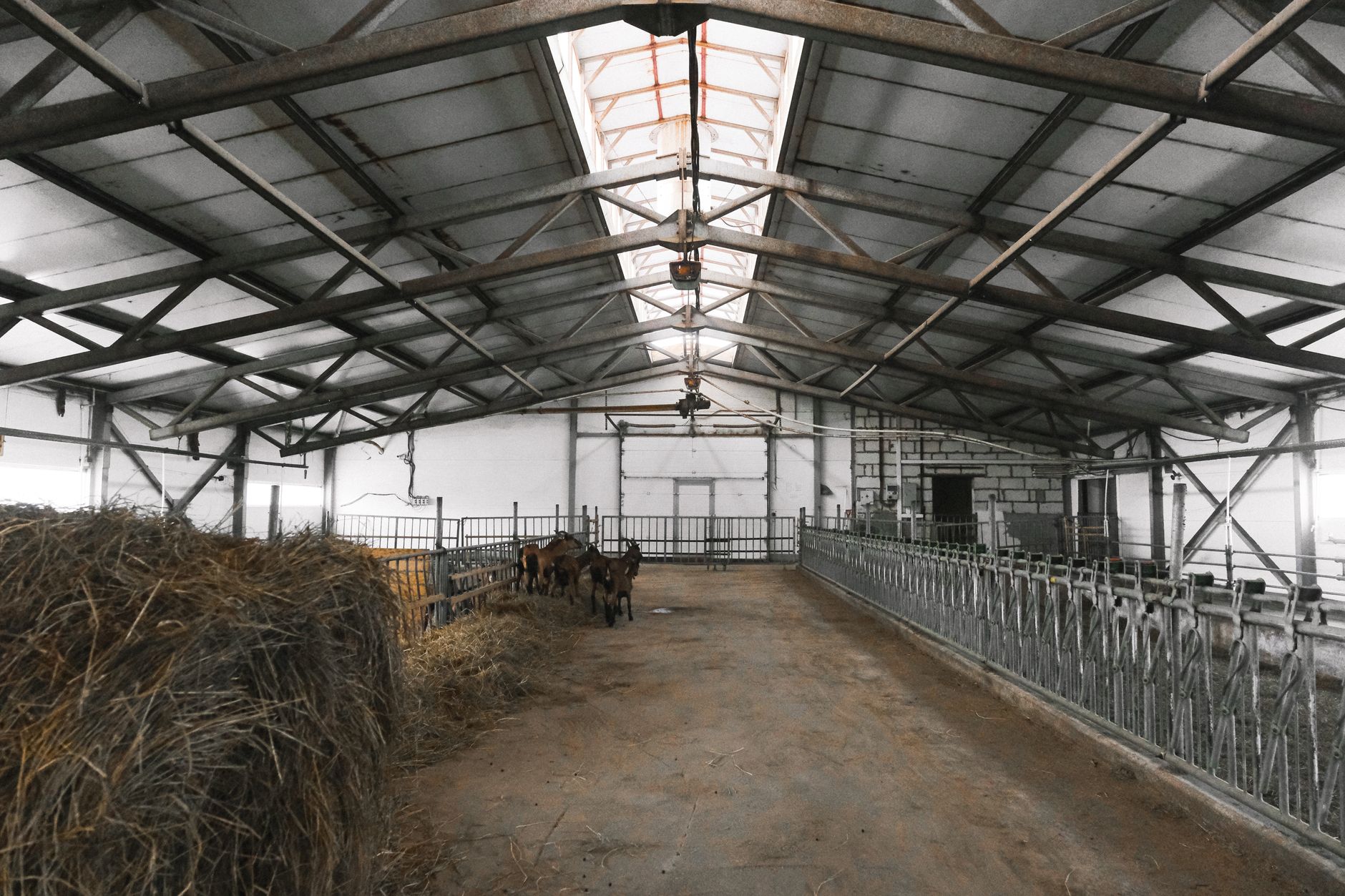
Why does an agricultural building or barn present a particular fire risk?
An agricultural building combines several risk factors rarely found together elsewhere: large quantities of combustible materials (hay, straw, bedding), large open volumes without compartmentation, an atmosphere laden with organic dust and sometimes ammonia, and human presence often limited to a few visits per day. A fire starting in a hay bale can smoulder for several hours before breaking out, then spread very quickly in an uncompartmented volume. Fire is among the top ten causes of bankruptcy in Belgium, and 70% of businesses affected by a major incident never recover (European Fire Sprinkler Network). For a farm, the loss of the building is often accompanied by the loss of livestock or harvest, making early detection critical.
Why are conventional point smoke detectors unreliable in this context?
Optical point smoke detectors, designed for office or residential environments, quickly become clogged in a barn or hay storage building due to airborne organic dust (straw, cereals, bedding). This clogging causes either repeated false alarms or, conversely, a loss of sensitivity that delays actual detection. Ammonia released by animal waste also accelerates corrosion of unprotected electronic components. Added to this is the frequent ceiling height in these buildings, which dilutes smoke before it reaches a detector installed on the ceiling. For these reasons, conventional point detection is generally not recommended as the primary solution in this type of volume, except in partitioned and less dusty ancillary rooms (farm office, technical room).
What is linear detection and why is it suitable for large agricultural volumes?
Linear detection works by an infrared beam emitted between a transmitter and receiver, or reflected on a mirror: any smoke crossing the beam attenuates the signal and triggers the alarm. This principle covers a large distance in a single line, making it an effective solution for monitoring a hay storage building or large-volume barn without multiplying detection points. It is less sensitive to progressive clogging than point detectors, because beam fouling is automatically compensated up to a certain threshold, with fault signalling if the threshold is exceeded. Installation must respect rigorous alignment between transmitter and receiver, a point to check during each periodic inspection, as structural vibrations (metal cladding, timber frame) can misalign the beam over time.
What is a rate-of-rise heat detector and when should it be installed?
A rate-of-rise heat detector responds to the speed of temperature rise rather than a fixed threshold, allowing it to detect a rapid fire start without being disturbed by slow ambient temperature variations typical of a barn (animal heat, ventilation, seasons). This type of detector is particularly suited to areas where smoke is an unreliable indicator, for example near electrical equipment, ventilation motors or in very dusty rooms where a smoke detector would constantly saturate. It often complements linear detection rather than replacing it: the beam monitors the overall volume, the rate-of-rise detector covers identified hot spots (electrical panels, grain silos, equipment storage areas).
How to adapt alarm transmission in the absence of permanent personnel?
The frequent absence of personnel in agricultural buildings requires remote alarm transmission to the operator or a monitoring service, otherwise a detection triggered at night or during an absence serves no purpose. A simple local sounder is not sufficient if no one is on site to hear it. The system must therefore provide alarm relay by telephone or GSM transmitter to one or more designated numbers, with a clear procedure on what action to take (remote verification, call to the emergency zone [hulpverleningszone]). This point is all the more important as 70% of fire victims in Belgium are killed at night by smoke, and half of the deaths recorded in 2025 occurred during night fires: an unoccupied agricultural building at night follows the same logic of deferred risk.
What other technical constraints must be anticipated in this type of building?
Ammonia and ambient humidity require choosing equipment whose housing and electronic boards resist corrosion, with a protection rating suited to the environment (dust, splashes). Extreme temperature variations between summer and winter, common in uninsulated buildings, must also be considered when selecting components. Finally, electrical supply is sometimes limited or shared with other farm equipment: the detection system must have its own backup power supply to remain operational in the event of a power cut, a situation that is not rare in isolated farms. These constraints explain why BOSEC-certified equipment, designed to withstand severe conditions, is preferable to entry-level equipment.
Which technology to choose according to the type of agricultural building?
The choice depends on volume, occupancy and the nature of the stored risk. The following table summarises recommended uses according to building configuration.
| Technology | Principle | Suitable for | Main limitation |
|---|---|---|---|
| Optical point detector | Responds to visible smoke particles | Partitioned ancillary rooms, farm office | Rapid clogging by organic dust |
| Linear detection (IR beam) | Attenuation of an infrared beam over a large distance | Hay storage building, barn, large open volume | Requires stable alignment, sensitive to structural vibrations |
| Rate-of-rise heat detector | Responds to speed of temperature rise | Areas near electrical panels, motors, silos | Does not detect smouldering fires without flame |
| Flame detection (UV/IR) | Responds to flame radiation | High-risk storage areas, very dry hay | Limited field of view, requires direct line of sight |
What standards and inspections apply to these installations?
The design of a fire detection system in Belgium follows standard NBN S21-100-1, which sets the rules for installation and sizing, while standard NBN S21-100-2 governs its maintenance and periodic inspection once installed. The actual obligation to equip an agricultural building depends on its precise use, the presence of workers (in which case the Code on Well-being at Work [Codex over het welzijn op het werk], Book III Title 3, applies) and any requirements of the insurer or the opinion of the competent emergency zone. ANPI can be consulted for risk analysis of a specific project. In all cases, installed equipment must be BOSEC-certified and installation carried out by a professional who documents periodic inspections in a register, a condition often required by agricultural insurance companies.