What rules does the Royal Decree of 7 July 1994 impose on performance venues?
The Royal Decree of 7 July 1994 establishing basic standards for fire and explosion prevention applies to performance venues, cinemas and theatres as to any building accessible to the public. This text classifies buildings according to their height (low, medium or high building) and imposes, according to this category, requirements for compartmentation, evacuation routes, smoke extraction and fire detection.
For a performance venue, the actual configuration matters as much as the building height: seating capacity, presence of a stage area, projection booth, dressing rooms, public foyers. The competent emergency zone (hulpverleningszone) examines the file before opening and may impose additional measures adapted to the actual operation of the premises, beyond the regulatory baseline.
This framework does not distinguish a separate regime specific to performance venues as a sectoral text would: it applies according to the building configuration and actual use, which requires the operator to precisely identify the risks related to their activity.
Why does the dark room complicate fire detection?
A dark room (cinema during projection, theatre during performance) eliminates spontaneous human detection of a fire outbreak: no one notices emerging smoke in the dark, and the audience remains still and focused on the stage or screen. Detection must therefore be entirely automatic, without depending on visual vigilance from the public or staff.
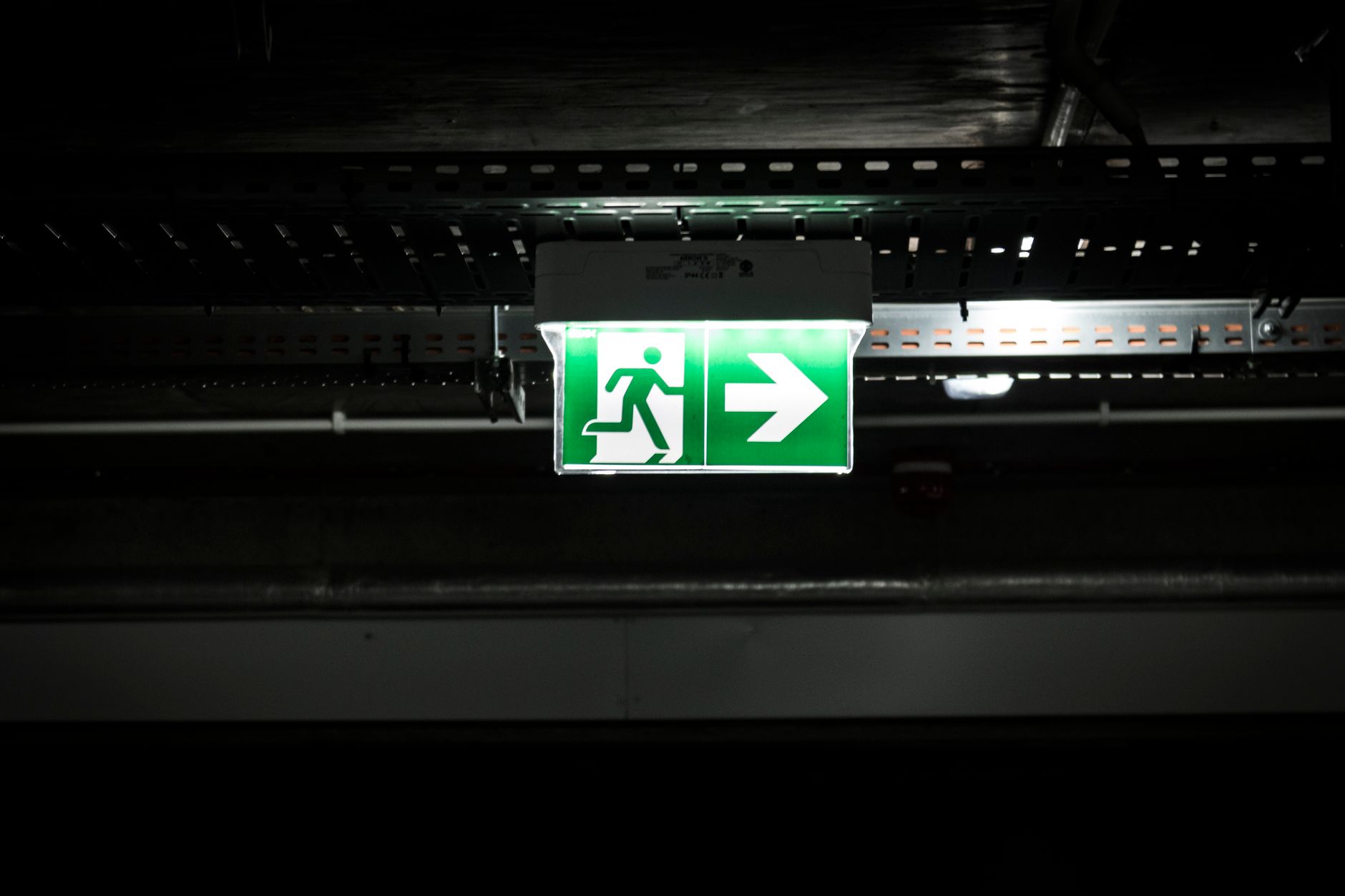
This constraint has two concrete consequences. On one hand, coverage by automatic detectors (optical smoke detectors in particular) must be generalised in the room itself, not only in circulation areas. On the other hand, emergency exit marking must remain perceptible despite the darkness sought for the show, which requires emergency lighting that triggers automatically upon alarm, independently of stage or projection lighting.
The NBN S21-100-1 standard frames the design of these detection installations, taking into account the actual configuration of the premises to be protected.
What type of fire detection must be installed in a cinema or theatre?
Generalised automatic detection is the reference for performance venues, due to significant occupancy and darkness during performances, in accordance with the design principles of NBN S21-100-1. Each zone of the building requires technology adapted to its specific risk.
| Zone | Dominant risk | Adapted detection |
|---|---|---|
| Auditorium (public) | Smoke in dark environment, high occupancy | Generalised optical smoke detectors |
| Projection booth or control room | Heating of electrical equipment | Heat detectors or combined |
| Stage area, sets | High fire load, combustible materials | Enhanced automatic detection, associated smoke extraction |
| Dressing rooms, technical rooms | Electrical appliances, material storage | Smoke or heat detectors depending on use |
| Foyers, public circulation areas | Crowds at entry and exit times | Smoke detection, evacuation signage |
Large venues with stage areas require additional protection measures for the stage itself (stage area smoke extraction, sometimes fire curtain), to be adapted according to actual configuration and volume concerned.
How is evacuation organised during a performance?
Evacuation of a performance venue relies on a number of exits sized to seating capacity, emergency lighting that triggers automatically upon alarm, and exit marking that remains visible even in dark configuration. These three elements are inseparable: a sufficiently wide exit is useless if it cannot be located in the dark when the alarm sounds.
The alarm scenario deserves particular attention in these high-occupancy establishments. An immediate general audible alarm, in a full room and in darkness, can generate a panic movement more dangerous than the fire itself if evacuation is not channelled. The operator must therefore consider, with their installer and the emergency zone, alarm delay, progressive lighting of the auditorium, and training of staff responsible for guiding the public to exits.
This point relates to the general obligations of the Code on Well-being at Work (Book III, Title 3) concerning fire prevention in the workplace, which requires the employer to organise evacuation and train present staff.
Who issues the authorisation to operate a performance venue in Belgium?
The emergency zone (hulpverleningszone) competent for the territory where the performance venue is located provides a prior opinion before opening to the public, based on a file including building plans, description of detection and alarm installations, and equipment conformity certificates. This opinion conditions the operating authorisation issued by the municipal authority.
Beyond this initial opinion, the emergency zone conducts periodic inspections whose frequency is set locally according to building category and use. For a high-attendance performance venue, these inspections focus as much on the condition of technical installations as on the concrete organisation of evacuation: effective width of exits, clearance of corridors, actual operation of emergency lighting.
The operator should request this opinion well before the planned opening date, as processing times and any required compliance measures can be substantial for an establishment of this nature.
What maintenance for detection installations in a performance venue?
Maintenance and inspection of fire detection installations in a performance venue fall under standard NBN S21-100-2, which sets the operations to be performed and their frequency to ensure proper system operation over time. This maintenance must be provided by an installer whose teams and products have BOSEC certification, recognised by emergency zones and the ANPI organisation.
In a performance venue, verification covers sensitive points beyond the detector itself: effective triggering of emergency lighting upon alarm, readability of marking in darkness, and absence of access obstruction over the course of set changes or room layout modifications. Each intervention must be recorded in the building's safety register, a document that the emergency zone consults during its periodic inspections and which traces the complete history of verifications and any corrected anomalies.