What general rules govern fire detection in a sports centre?
A sports centre accessible to the public (multi-purpose sports hall, swimming pool, fitness centre with public access) falls under the Royal Decree of 7 July 1994 establishing basic standards for fire and explosion prevention, which classifies buildings according to their height (low, medium, high) and imposes requirements for compartmentation, evacuation and detection adapted accordingly. The design of the detection installation follows standard NBN S21-100-1, which requires a preliminary analysis of each room (volume, ceiling height, humidity, dust) before choosing the type and implantation of detectors. For rooms occupied only by staff (technical rooms, storage areas), the Code on Well-being at Work (Book III, Title 3) also applies. The territorially competent emergency zones (hulpverleningszones) provide an opinion on the project and inspect the installation once installed.
How should detection adapt to the large volumes of sports halls?
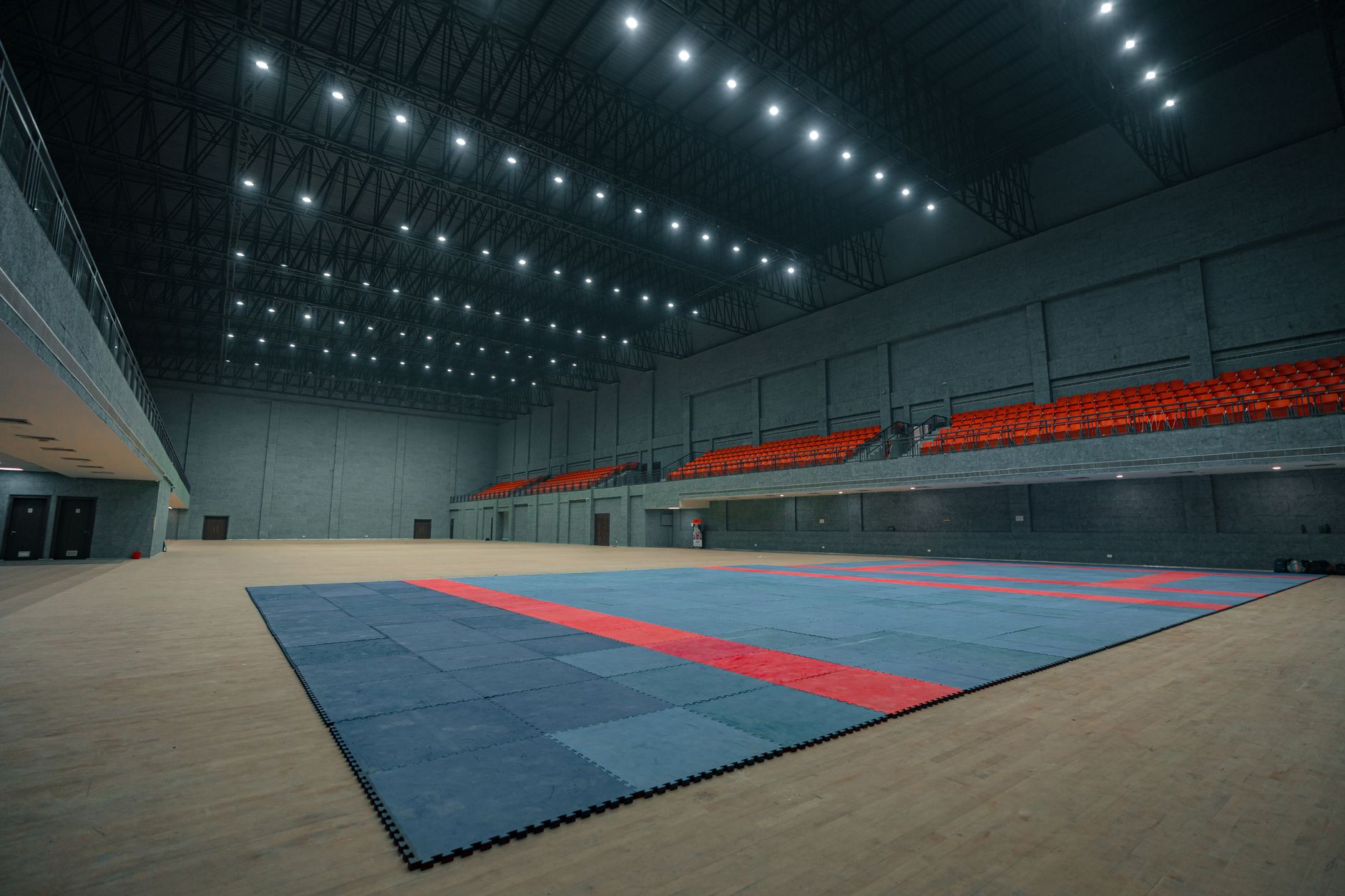
The large volumes of sports halls (gymnasiums, Olympic swimming pools, multi-purpose halls) pose a specific problem: smoke can stratify and cool before reaching point detectors installed too high, which delays detection. Standard NBN S21-100-1 requires a specific study of implantation in these volumes, taking into account ceiling height and room configuration (framework, mezzanines, stands). In the highest volumes, conventional point detectors are generally not sufficient: complementary technologies such as linear detection (beam) or aspiration detection should be considered according to the risk analysis. The error often consists of applying a standard office implantation to a volume several metres in ceiling height, without considering smoke stratification.
What requirements apply to wet areas such as swimming pool basins?
Pool surroundings require the choice of detectors resistant to humidity, condensation and chlorinated vapours, as an aggressive environment prematurely degrades unsuitable components and generates false alarms. Standard NBN S21-100-1 explicitly requires adapting detection technology to the room environment: conventional smoke detectors installed directly above a pool are exposed to permanent condensation that disrupts their operation. Common solutions consist of moving the sensitive component away from the wet area (aspiration detection with remote sampling tubes) or using detectors whose housing and electronics are specifically protected against humidity and corrosion. Cabling and connection boxes must also be chosen accordingly, otherwise recurrent failures will occur in the months following commissioning.
What requirements apply to changing rooms and stands?
Changing rooms with showers generate steam that can trigger false alarms if the detector is not chosen according to this environment, while stands create hollow volumes (under seats, storage areas) often forgotten during implantation. Standard NBN S21-100-1 requires treating these rooms as areas with their own risk, distinct from the main sports hall. Under stands, one frequently finds storage rooms, technical cabinets or unprotected passage areas when they constitute a significant combustible volume. The audible alarm must also remain audible above the ambient noise specific to these infrastructures (public, matches, music), which sometimes requires multiplying sound diffusers rather than settling for the standard implantation of a tertiary building.
What are the most frequent implantation errors in this type of infrastructure?
Implantation errors observed in sports centres almost always come down to the same points, identifiable from the design stage if the risk analysis required by NBN S21-100-1 is properly conducted.
- Point detectors placed at the highest point of a sports framework, without considering smoke stratification in a large volume.
- Detectors installed directly above a pool, exposed to permanent condensation that causes failures and false alarms.
- Absence of detection under stands, when these volumes often house storage or technical equipment.
- Changing rooms equipped with detectors unsuitable for shower steam, generating nuisance triggering.
- Cabling and boxes not resistant to a chlorinated environment, source of premature degradation of the installation.
- Insufficient sound diffusers to cover the ambient noise of an active sports hall.
What inspection frequency applies to these installations?
NBN S21-100-2 governs the maintenance and inspection of fire detection installations, with a complete inspection at least annually carried out by a qualified person, and more frequent inspections for components subjected to an aggressive environment such as pool surroundings or wet changing rooms. A sports centre often combines several different environments (large dry volume, wet area, technical room), which justifies a differentiated maintenance plan rather than a single frequency applied to the entire building. Using a BOSEC certified installer and following ANPI recommendations allows documenting this maintenance. The competent emergency zone remains the contact for periodic inspections and may require updating the technical file in case of building modification (extension, new stands, change of room use).