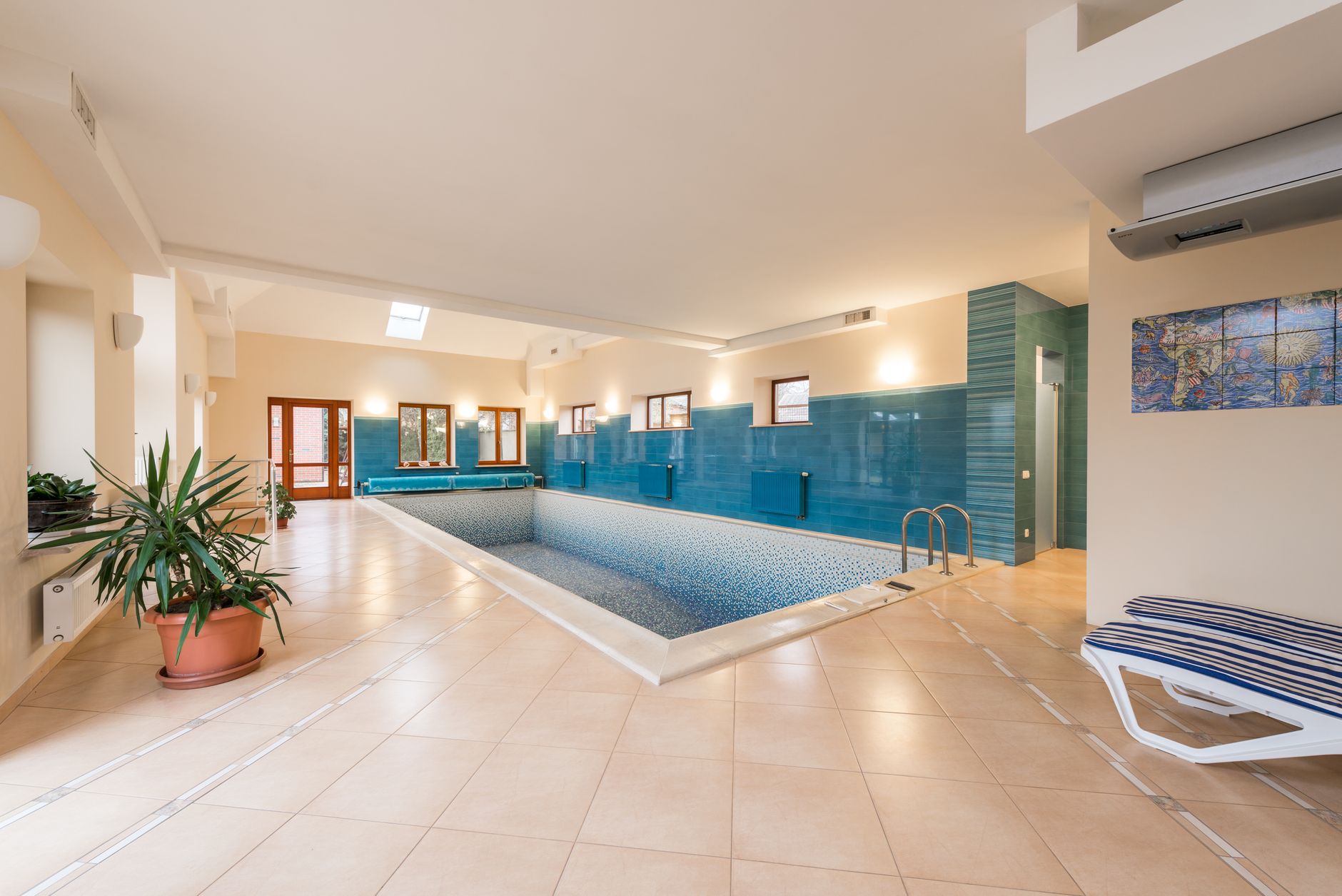
What fire detection obligations apply to swimming pools and sports centres?
Belgian swimming pools and sports centres are buildings accessible to the public and as such fall under the Royal Decree of 7 July 1994 establishing basic standards for fire and explosion prevention. This legislation classifies buildings as low, medium or high according to the height of the highest level relative to the evacuation level, and requires a risk analysis specific to each configuration.
A sports hall or covered pool presents particular characteristics: large volume, ceiling height often exceeding 10 metres, metal or timber framework, presence of changing rooms and technical rooms (boiler room, water treatment) with higher risk than the hall itself. The design of the detection installation must follow standard NBN S21-100-1, which requires defining detector placement based on the actual volume of the room rather than a theoretical surface area. In a sports centre with multiple activities (swimming pool, sports hall, cafeteria), each zone may be subject to different requirements depending on its use and risk.
Why do humidity and condensation complicate fire detection in these buildings?
The ambient humidity of a covered pool causes condensation on cold surfaces, including inside detectors if they are not designed for this use. A conventional optical smoke detector, sensitive to airborne particles, frequently interprets mist or chlorinated spray as the start of a fire, generating false alarms.
This phenomenon is not merely a nuisance: each false alarm erodes the confidence of occupants and staff in the system, with the risk that a real alarm may be dealt with belatedly. Air laden with water vapour and treatment products (chlorine, chlorine derivatives) also accelerates corrosion of unprotected electronic components, reducing equipment lifespan. Standard NBN S21-100-1 requires environmental conditions (temperature, humidity, dust, vapours) to be taken into account when selecting and positioning detection equipment, making risk analysis all the more critical in this type of building.
Which detectors should be chosen for a sports hall or covered pool?
In a covered pool or humid sports hall, standard optical smoke detectors are generally ruled out in favour of technologies less sensitive to humidity: heat detectors, linear infrared beam detectors or aspiration detection systems (ASD, aspirating smoke detection). The choice depends on the room configuration and the type of combustible material present.
| Technology | Behaviour in humid environment | Recommended use |
|---|---|---|
| Standard optical smoke detector | Sensitive to condensation, frequent false alarms | To be avoided in pool areas, possible in dry changing rooms |
| Heat detector | Little sensitivity to humidity, reacts to temperature rise | Boiler rooms, technical rooms, areas with heavy dust |
| Linear beam detector | Covers large volumes, sensitive to mist if poorly positioned | High-ceiling sports halls, stands |
| Aspiration detection (ASD) | Electronic unit remote from humid zone, air analysed remotely | Large volumes, pools, frameworks difficult to access |
The housing of detectors installed in pool areas must have an IP protection rating suitable for water spray and saline atmosphere, and cabling and connectors must be chosen accordingly to limit long-term corrosion.
How does high ceiling height influence detector choice and placement?
The high ceiling height of a sports hall or covered pool delays smoke reaching conventional detectors, as smoke dilutes and cools as it rises, losing the buoyancy that carries it to the ceiling. Beyond a certain height, a conventional point detector fixed to the ceiling loses reliability.
This is why standard NBN S21-100-1 requires adapting the technological choice to the actual volume to be monitored rather than applying theoretical spacing designed for standard ceilings. In these configurations, a linear beam detector, positioned horizontally at an intermediate height, or aspiration detection with several sampling points distributed throughout the volume, offer better sensitivity than a grid of point detectors. The metal or timber framework typical of sports halls also complicates access for maintenance, a criterion to be integrated from the design stage so that the periodic inspections required by NBN S21-100-2 remain feasible without a lift platform at each intervention.
Which Belgian standards govern the design and maintenance of these installations?
The design of a fire detection installation in Belgium follows standard NBN S21-100-1, which sets the rules for placement, zoning and equipment selection according to risk and room volume. The maintenance and periodic inspection of these installations fall under standard NBN S21-100-2, which requires regular checks of operation, detectors, control panel and alarm devices.
For a sports facility, the Code on Well-being at Work (Book III, Title 3, devoted to fire prevention in the workplace) applies in addition where staff are employed, particularly for technical rooms such as the boiler room or water treatment room. The operator of a sports centre or swimming pool must therefore reconcile requirements related to public access (Royal Decree of 7 July 1994) with those related to the presence of workers, which often leads to differentiated levels of protection between the hall itself and its ancillary rooms.
Who inspects these installations and how frequently?
Periodic inspection of a fire detection installation in a Belgian swimming pool or sports centre combines the technical verification provided for by NBN S21-100-2 and the opinion of the competent fire service, i.e. the emergency zone (hulpverleningszone) with jurisdiction over the building. The emergency zone issues an opinion during construction or major modifications, and may carry out inspections during visits.
Installed equipment must be BOSEC certified where this certification exists for the product category concerned, which guarantees its compliance with Belgian standards in force. ANPI publishes reference documents useful to operators and installers for the application of these standards. In a building subject to particular humidity and corrosivity such as a covered pool, the frequency of maintenance inspections deserves to be tightened compared to the normative minimum, as equipment degradation can be faster there than in a dry environment.