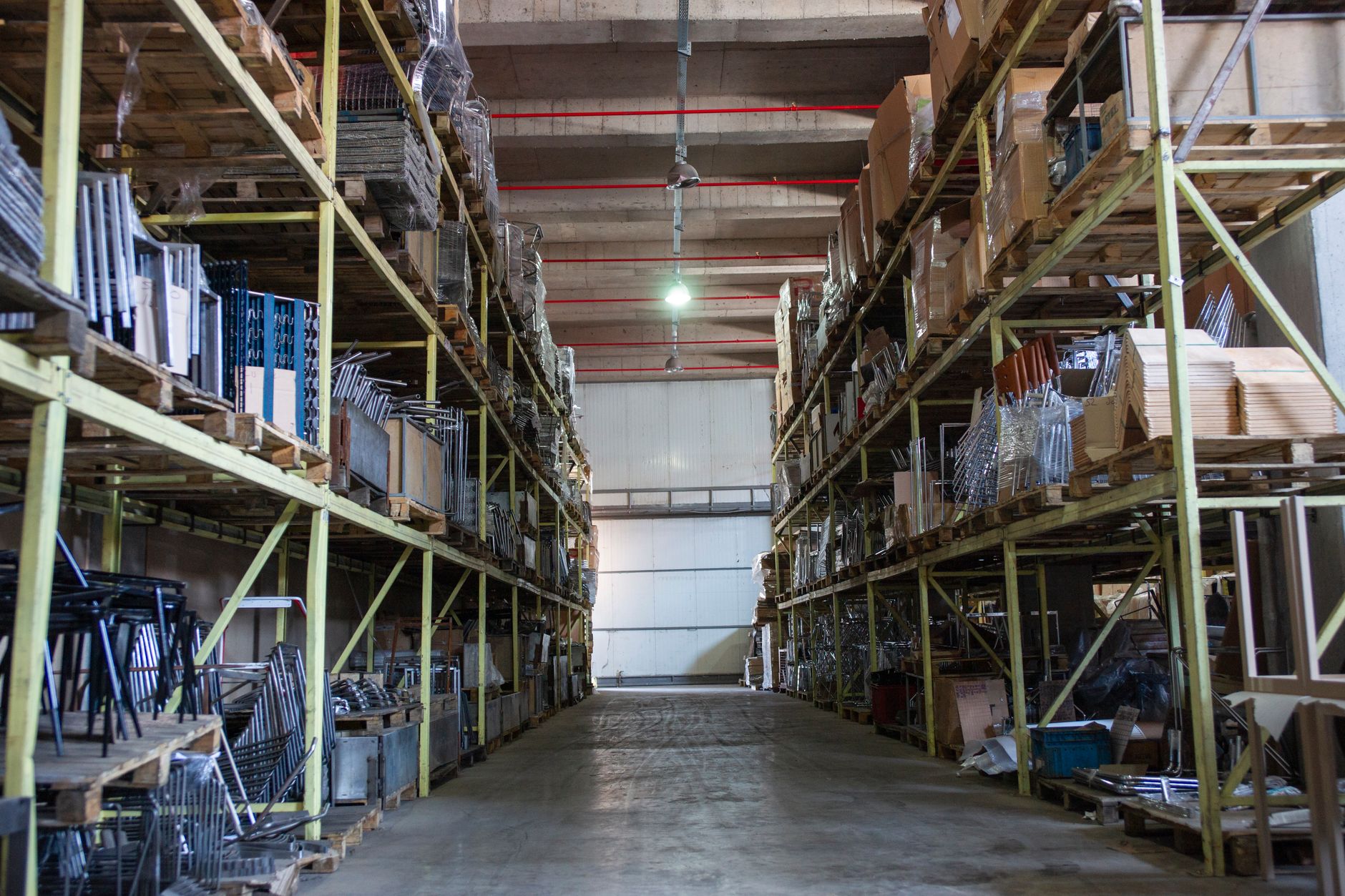
Why Does High Ceiling Height Complicate Fire Detection?
A warehouse with high storage height poses a simple physical problem: hot smoke rising from a fire located at rack level must travel a significant distance before reaching detectors installed on the roof. At ceiling heights of 10, 15 or 20 metres, this journey takes time, and the smoke cools as it rises. A conventional point detector placed only on the roof may thus detect a fire well after its actual start, while the calorific load of stored goods (pallets, plastics, cardboard) allows very rapid propagation once the fire is established. This is why the design of a fire detection system for this type of building cannot be limited to standard ceiling installation: it must integrate height as a dimensioning parameter, in the same way as surface area or stored activity.
What Is Thermal Stratification and Why Does It Delay Detection?
Thermal stratification refers to the phenomenon whereby smoke from a fire, cooling during its ascent, stops rising before reaching the ceiling and stabilises at an intermediate altitude, in a horizontal layer. In a high-volume space, this layer can form at mid-height of the building, out of reach of detectors installed on the roof. The phenomenon is amplified by a significant temperature differential between the warm ambient air under the roof (especially in summer or in a poorly ventilated warehouse) and the smoke produced by an incipient fire, still relatively low in energy. Concretely, this means that a system designed only for a standard height of 3 to 4 metres cannot be transposed as such to a 15-metre warehouse: the detection delay lengthens, and the fire can reach an advanced development phase before any alarm.
What Types of Detectors Should Be Chosen for a High Storage Warehouse?
Three families of technologies are combined or substituted depending on the building configuration and the nature of the stored risk: linear detection, cascading point detection, and aspiration detection. None is universally superior; the choice depends on the exact height, the presence of racks, the type of goods and operational constraints (forklifts, stackers).
| Technology | Principle | Advantage at High Height | Limitation |
|---|---|---|---|
| Linear detection (optical beam) | Infrared beam between transmitter and receiver, interrupted by dense smoke | Covers large areas at a given level | Not very sensitive to diluted smoke at the start of an incident |
| Cascading point detectors | Multiple levels of point detectors superimposed over the building height | Captures smoke at different altitudes, including below the stratification layer | Requires cabling and supporting structure at multiple levels |
| Aspiration detection (ASD) | Network of tubes that continuously aspirate air to a highly sensitive analysis unit | Detects smoke at very low concentrations, before complete stratification | Higher installation and maintenance cost |
In many Belgian logistics warehouse projects, the chosen solution combines multiple levels of cascading detectors with a complementary aspiration network, rather than a single isolated technology.
How Does Aspiration Detection Work at High Height?
Aspiration detection (ASD, Aspirating Smoke Detection) is based on a network of perforated tubes that continuously sample small volumes of air at different points in the monitored volume, and convey them to a highly sensitive optical analysis unit. This technology is of particular interest at high height: the sampling points can be positioned at multiple levels along the tubes, which allows smoke to be captured before it stratifies completely, and thus gains valuable detection time compared to a conventional point detector on the roof. The sensitivity of these units allows detection of smoke concentrations well below the threshold of human perception, which is crucial in a warehouse where fire can smoulder for a long time in a pallet before producing visible flames. The counterpart is a more demanding investment and maintenance, with monitoring of proper aspiration flow on each tube in the network.
What Do Belgian Emergency Zones Recommend for This Type of Risk?
Belgian emergency zones (hulpverleningszones), consulted during the design or inspection of a detection system in a high storage warehouse, generally guide towards a combined approach rather than a single solution. Their opinion focuses in particular on the adequacy between the chosen technology and the actual ceiling height, the nature of stored goods, and the accessibility of the building for intervention (aisle width, presence of high racking). They also verify that the system provides sufficient cascading coverage when the height exceeds what a single level of point detectors can effectively cover. These recommendations do not replace the technical standard, but they are based on field feedback and fire cases encountered during interventions at comparable logistics sites. It is recommended to seek the opinion of the competent emergency zone upstream of the project, rather than after installation, to avoid a challenge to the dimensioning during periodic inspection.
Which Belgian Standards Govern the Design of These Installations?
The design of a fire detection installation in Belgium, including for a high storage warehouse, falls under standard NBN S21-100-1, which sets the principles of design and installation, while standard NBN S21-100-2 governs maintenance and periodic inspection once the system is in service. These standards do not set a single height threshold automatically triggering a particular technology: they require a risk study that takes into account the actual geometry of the volume, including ceiling height. The installed equipment must also have BOSEC certification, a recognised conformity guarantee in Belgium, and the installer can rely on technical opinions from ANPI for the most complex configurations. The general fire prevention framework remains set by the Royal Decree of 7 July 1994, but the detailed dimensioning of detection at high height primarily falls under engineering applied to NBN S21-100 standards.